Fort Bend County
AC repair and HVAC service in Sienna
Under construction continuously since 1996, so a 1998 house and a 2025 house sit inside the same community with almost nothing mechanically in common.
Local context
Thirty years of building, inside one community
Sienna held 20,204 residents at the 2020 census, up from 13,721 in 2010, across about 14 square miles. Johnson Development laid out the concept in 1978, including a ten-mile levee, then the 1980s recession stopped it. Work resumed in 1994 and the first homes sold in 1996.
The original seven villages are Steep Bank East, Steep Bank West, Shipman’s Landing, Waters Lake, Anderson Springs, Bees Creek and Avalon. Steep Bank East and West came first, built by David Weekley, Perry, Newmark, Emerald and Plantation. Construction has carried on southward ever since.
What that produces is a single community containing houses at every stage of the HVAC life cycle simultaneously. In the oldest villages, equipment is on its second replacement. In the newest sections, systems are still inside the builder warranty. Two houses four minutes apart can need entirely different conversations.
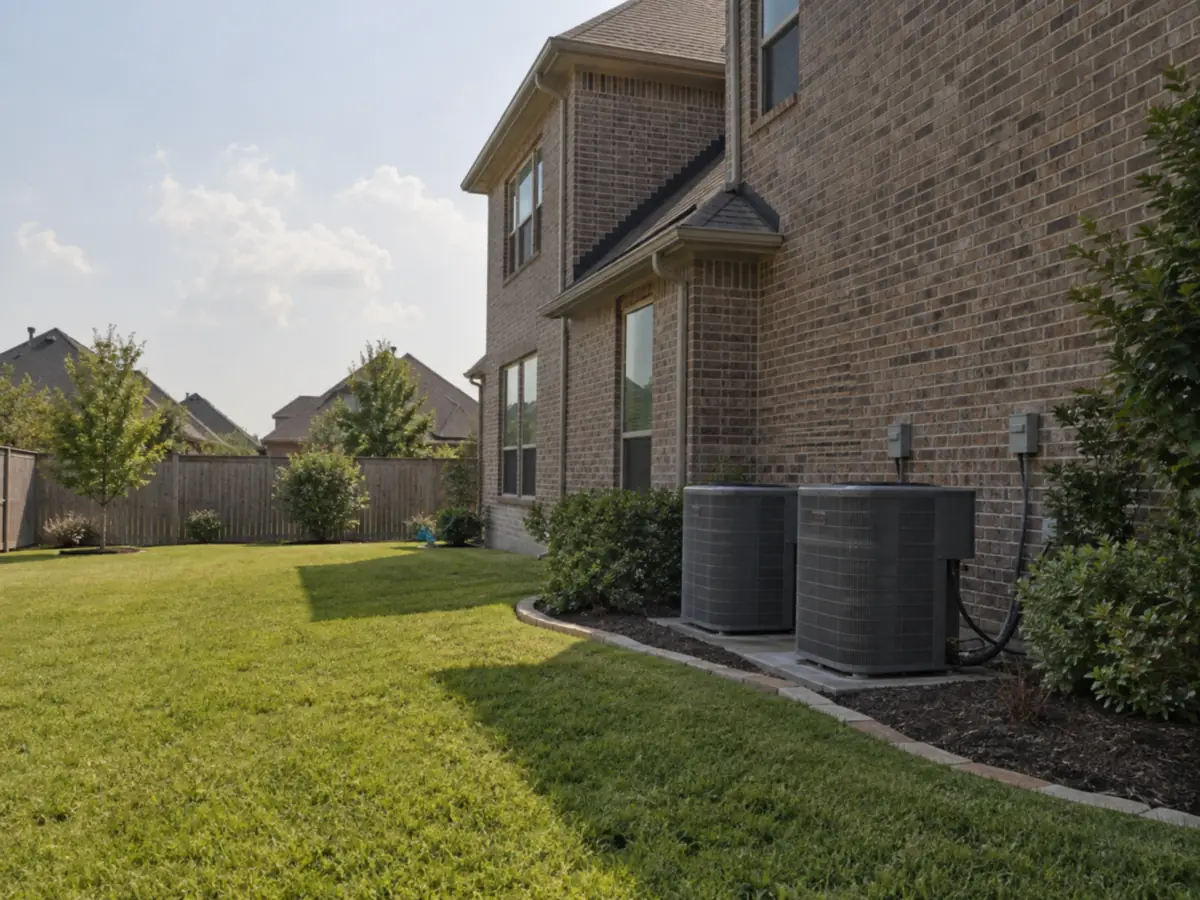
It also produces a lot of large houses. Plans here commonly run from around 1,800 square feet up past 4,200, and above roughly 3,000 square feet the standard local answer is two complete systems rather than one system with zoning.
Sienna at a glance
- Status: census-designated place, unincorporated
- Population: 20,204 at the 2020 census
- Area: about 14 square miles
- County: Fort Bend
- ZIP code: 77459
- First home sales: 1996
- Renamed: from Sienna Plantation in May 2019
Two-system houses
Two systems in one house is a different job from one system
They fail at different times
The upstairs system works harder in this climate, because it is fighting an attic that runs far hotter than outdoor air on a July afternoon. In a pair installed on the same day, it is usually the one that goes first. Planning for staggered replacement is more realistic than assuming both will last the same number of summers.
One can mask the other
When the upstairs system is struggling, the downstairs one often takes up some of the slack through the stairwell, which delays the moment anyone notices. The tell is a downstairs unit running far longer than it used to while the upstairs never quite satisfies. Worth mentioning on the phone, because it changes where a technician starts.
Mismatched ages compound
Replace one system and leave the other, and you now have two different refrigerants, two different efficiency ratings and two different service lives in one house. That is a perfectly reasonable position to be in. It is just worth choosing deliberately rather than discovering it later.
The diagnostic starting point is the same either way: which system, which floor, and what each one is actually doing. On a two-system house, describing the symptom as “the AC is not working” leaves out most of the useful information.
By village era
Where a house sits in the build-out tells you what to expect
Steep Bank East and West, Shipman’s Landing, Waters Lake. The late-1990s and early-2000s core. These houses have been through at least one changeout, and where that changeout was done to a price the ductwork was almost certainly left untouched. Original flexible supply duct here is now around a quarter of a century old and has had plenty of time to sag between supports and lose airflow at the bends.
The 2005 to 2015 sections. Larger plans, two-system layouts become common, and building envelopes tighten. Equipment is either original and approaching replacement or recently changed. Comfort complaints here are more often about distribution and humidity than about capacity.
The newest sections. Tight envelopes, good duct, modern equipment. The problem that shows up is a specific one: a well-sealed house with a generously sized system cools quickly, shuts off early, and never runs long enough to pull the humidity down. The house reads 73°F and feels clammy. That is a run-time problem rather than a capacity problem, and the fix is rarely a bigger system. See humidity control.
Across all three, the levee that made this land developable in the first place is a reminder that drainage here is engineered rather than natural. The same applies inside the house: condensate from an attic air handler leaves through a drain line somebody designed, and when it blocks, the water goes to the ceiling instead.
The villages
Sienna, north to south
Steep Bank and Shipman’s Landing at the older end, the newest sections furthest south, with Missouri City adjoining to the north and Highway 6 along the top.
Services here
HVAC work we do in Sienna
Zoning and airflow
Balancing and dampers for floors that will not behave together.
Upstairs not cooling
Still the most common complaint here, even in two-system houses.
AC replacement
Including the question of whether to do one system or both.
Humidity control
For tight newer houses that hit setpoint without ever feeling dry.
Ductwork
Testing distribution in the original villages before buying equipment.
Maintenance
Two systems means two sets of coils, drains and contactors.
Nearby areas and related pages
Missouri City
Immediately north, and the jurisdiction most Sienna addresses relate to.
Fresno
East across Highway 6, smaller houses and a different build era.
Sugar Land
North-west, where the same two-storey attic pattern runs older.
Zoning and airflow
What to try before assuming the system is undersized.
Indoor air quality
Why a tight new house can be cold and still feel damp.
AC replacement
Sizing and staging when a house has more than one system.
Sienna questions
Is it Sienna or Sienna Plantation?
My house has two air conditioning systems. Do I replace both at once?
Who issues the permit for HVAC work in Sienna?
Why is the upstairs uncomfortable when we have a dedicated system for it?
Which parts of Sienna do you cover?
Two systems, two floors, and usually only one of them misbehaving. Say which and we can narrow it down on the phone.
Call (855) 758-5353Upstairs system not keeping up?
It is the one that works hardest here, so it is usually the one that shows its age first. Worth diagnosing before the hottest week of the year does it for you.