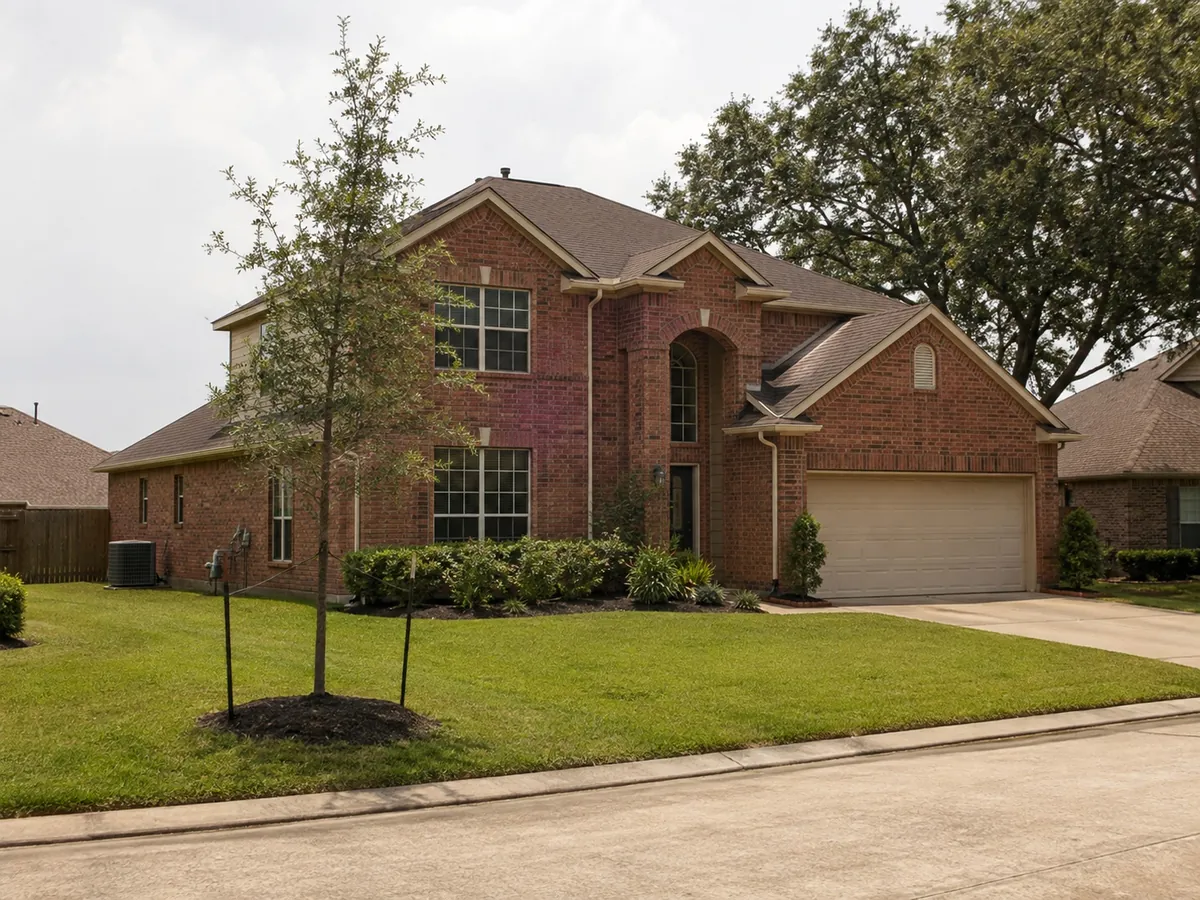
Comfort problem
Upstairs will not cool while downstairs is fine
The most common comfort complaint in two-storey houses across Sugar Land and Missouri City. It is a distribution problem far more often than an equipment problem.
Why this happens
Several things stack up against the upper floor of a Houston-area house at once. The attic above it is dramatically hotter than the outdoor air. The supply runs serving it are the longest and most restricted in the house. Cool air is denser and tends to settle downstairs. And the thermostat is usually downstairs, on the floor that was easiest to cool.
So the system satisfies a thermostat on the easy floor and stops, while the hard floor is still three or four degrees warm. Nothing is broken. The system is being asked the wrong question.
Worth checking yourself
- Every upstairs supply register fully open, and not blocked by furniture
- Upstairs return grilles clear, including any in ceilings
- Filter condition, since restricted airflow hits the longest runs hardest
- Whether bedroom doors are usually closed, which cuts off return air
- Any manual dampers on the trunk lines that may still be set for winter
Measure it. A cheap thermometer on each floor at 4pm on a hot day gives a number worth quoting on the phone.
Call (855) 758-5353Causes
What is normally behind it, in rough order
Return air, not supply air
The most under-diagnosed cause. A system can only deliver as much air as it can draw back, and many houses have return capacity sized for smaller equipment or concentrated entirely on the ground floor. Upstairs rooms with a supply register and no return path pressurise when the door is closed, which chokes the airflow into them.
Adding upstairs return capacity, or cutting properly sized transfer paths above doors, is frequently the single most effective change available and is cheaper than most alternatives.
Duct losses in a very hot attic
Upstairs supply runs pass through the hottest part of the house. Leaks in those runs dump conditioned air into the attic, and leaks on the return side pull superheated attic air into the system. With roughly 102 days a year above 90°F here, that loss is substantial. See ductwork.
Undersized or badly routed branches
Long flexible runs with sharp bends, sag between supports, or crushed sections deliver a fraction of their rated airflow. In houses built through the late eighties and nineties across Fort Bend County this is a routine finding, because the runs to upstairs bedrooms are the longest in the house and were often installed with the least care.
Thermostat location
One thermostat downstairs cannot represent two floors with different loads. This is not a fault so much as a design limitation, and it is exactly what zoning exists to solve.
Attic insulation and radiant load
Sometimes the honest answer is not in the HVAC system at all. Insufficient attic insulation, poor attic ventilation or a large area of west-facing upstairs glass creates a load the system was never sized to handle. Worth ruling in or out, because no amount of duct work compensates for a genuinely excessive load.
Genuine capacity shortfall
Occasionally the system really is too small, usually because square footage was added at some point without the system being reassessed. That is a different conversation and usually points at a second system or a dedicated ductless unit for the affected space.
Local pattern
Why this dominates in Fort Bend County
The housing stock explains a lot of it. First Colony began development in 1977, and Greatwood and New Territory followed at the end of the eighties. Sienna, Riverstone and Telfair are much newer. Across all of them, two-storey construction with a single attic air handler is the dominant pattern.
In the older master-planned neighbourhoods, the recurring findings are long flex runs with sag and sharp bends, a single central return sized for the original equipment, and duct that has never been tested for leakage in thirty years.
In the newer communities the duct is generally in better condition and the problem is more often design: a room over a garage, a bonus room, or a two-storey entry volume that one thermostat was never going to balance.
Both are solvable. They just get solved differently, which is why the visit starts with measurements rather than with a quote.
Worth knowing before you call
- The actual temperature difference between floors on a hot afternoon
- Whether it is the whole upper floor or specific rooms
- Where the thermostat is, and on which floor
- Whether there is one system or two
- Roughly when the house was built
24/7 emergency HVAC service. Office monday - saturday, 9:00am - 6:00pm.
Related pages
Zoning and airflow
Dampers, zoning and balancing, and the order to try them in.
Ductwork
Leakage, sizing and the return capacity that usually needs correcting.
Hot and cold spots
When it is individual rooms rather than a whole floor.
Mini-splits
Adding capacity to one problem space without touching the main system.
AC replacement
The natural moment to fix this permanently rather than inherit it again.
Sugar Land
Local housing stock and what we find in it.
Reviews
What customers say
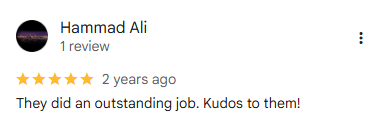
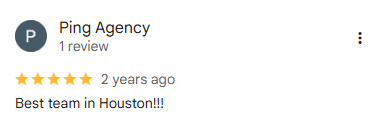
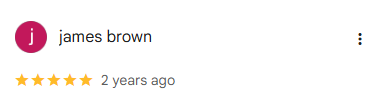
Every published review is five stars, on Google and on Yelp. These are screenshots of the live profiles.


Why people call us
Why homeowners here choose Haswani
Three things that are checkable rather than assertable. Each one is either a number you can verify or something the company can actually do.
The reviews are screenshots, not retyped quotes
All 12 reviews on this site are shown as screenshots of the live Google and Yelp profiles, ten on Google and two on Yelp. A quote retyped into a web page is indistinguishable from one a marketer invented; a screenshot carries the platform’s own chrome, the reviewer’s name and the date. No average rating is claimed anywhere, because 12 screenshots prove these reviews exist without proving they are the complete set.
A duct that has to move does not become somebody else’s job
Haswani runs HVAC alongside construction, electrical and plumbing. A large share of comfort complaints are building problems rather than equipment failures: a return opening undersized when the house was framed, a duct run that has to be rerouted, a circuit that will not carry the new equipment. Most HVAC companies stop where the building begins and hand that off. Here it stays with the same company.
Somebody answers at two in the morning
Emergency HVAC service runs around the clock. Cooling failures are not spread evenly across the year: they cluster on the hottest afternoons, in a city averaging 102 days at or above 90°F. Office hours are monday - saturday, 9:00am - 6:00pm, and the emergency line is not bound by them. The office is on Murphy Road in Stafford, which puts the core service area within about fifteen minutes.
Upstairs cooling questions
How many degrees difference between floors is normal?
Would a bigger air conditioner fix it?
Should I close the downstairs vents to push more air upstairs?
Is a second system or zoning better?
A measured temperature difference between floors is worth more on the phone than any description.
Call (855) 758-5353Nobody can sleep upstairs in July?
This is fixable and it usually does not need a new system. It does need somebody to measure airflow rather than guess at capacity.