Comfort problem
Hot and cold spots between rooms
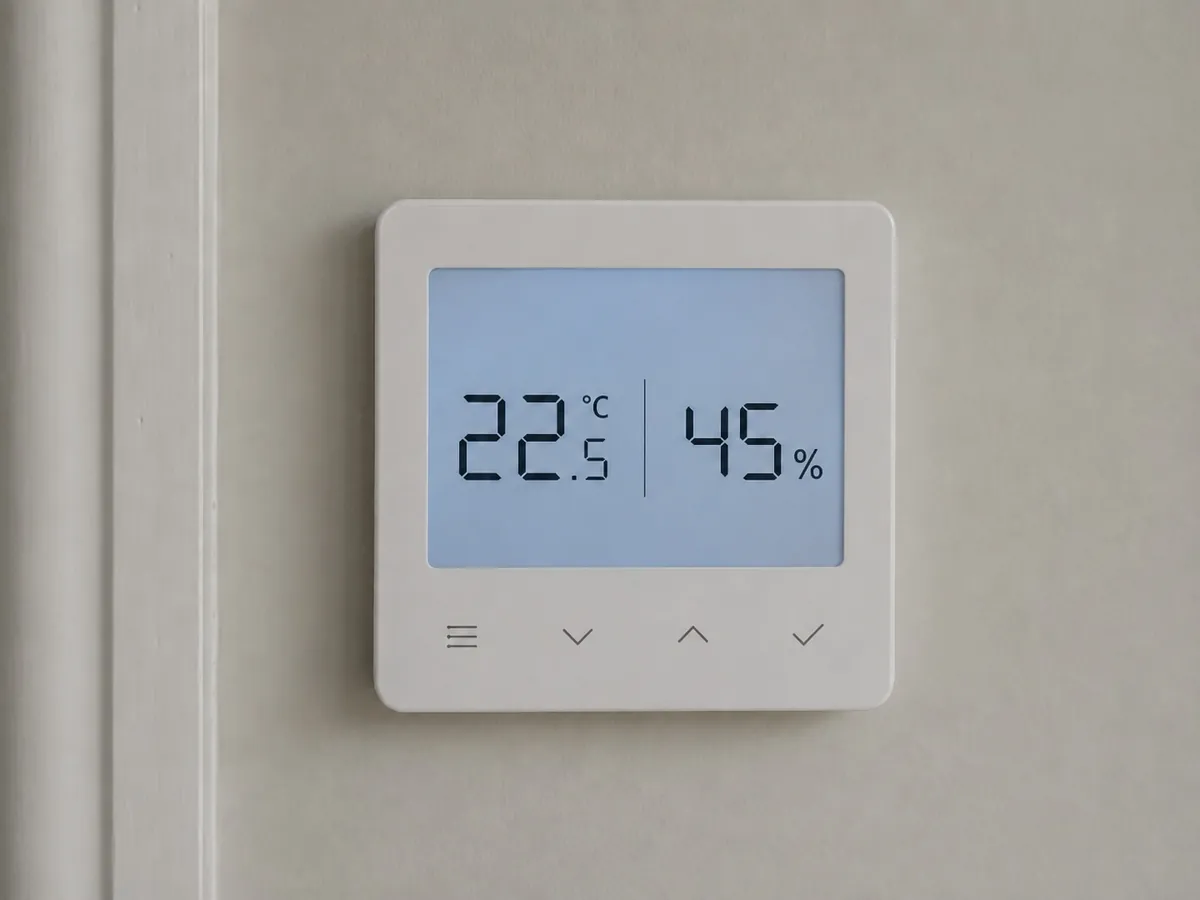
The thermostat says 74°F, one bedroom is 80°F and the study is cold enough for a jumper. That is a distribution problem, and it is measurable.
Two things create every hot room
How much conditioned air arrives, and how much heat the room gains. Every uneven-cooling complaint is some combination of the two, and telling them apart is what determines the fix.
Airflow problems are about duct: length, sizing, leakage, damper position and return path. Heat gain problems are about the room: glazing, orientation, insulation, what is above it and what is below it.
A room over a garage with west-facing windows at the end of the longest duct run has all of it at once, which is why that room is so often the one people call about.
Free checks worth doing
- Every register in the affected room fully open and unobstructed
- Nothing covering return grilles, including rugs over floor returns
- Whether the door is usually closed, which cuts the room off from the return
- Whether air is genuinely coming out of the register, or barely moving
- Whether the room has a ceiling fan, which helps more than people expect
Hold a hand at each register. A room getting noticeably less air than its neighbours is an airflow problem, not a heat gain one.
Call (855) 758-5353Causes
Working out which one you have
Airflow causes
Long or restricted duct runs. The register furthest from the air handler gets the least air. Flexible duct with sharp bends, sag between supports or a crushed section loses a substantial fraction of its rated flow.
No return path. A bedroom with a supply register and no return, whose door gets closed, pressurises against the incoming air. Airflow into it drops, and it becomes the room that is always warm. Undercut doors and transfer grilles exist to solve exactly this.
Damper positions. Manual dampers set once and never revisited, often left in a winter position, quietly starve part of the house all summer.
Duct leakage. A branch that has partially separated at a takeoff delivers most of its air to the attic. The room served by it never gets comfortable and nobody can see why. See ductwork.
Heat gain causes
Orientation and glazing. A west-facing room with large windows can gain heat far faster in the late afternoon than a north-facing room of the same size. If the room is only uncomfortable from 3pm onward, that is the signature.
Rooms over garages. Attic above, unconditioned space below, and usually an exterior wall on three sides. Consistently the hardest room in a house to condition.
Bonus rooms and converted spaces. Often built into the roof structure with limited insulation depth and served by an extension of the existing duct rather than by anything designed for the load.
Insulation gaps. Attic insulation that has been disturbed by other trades working up there, or was thin to begin with above one part of the house.
How to tell them apart
A room that is uncomfortable all day, evenly, and has weak airflow at the register is an airflow problem. A room that is fine in the morning and unbearable by late afternoon, with normal airflow, is a heat gain problem. A room with both gets both treatments.
The fix
What air balancing actually involves
Balancing is measurement followed by adjustment, not guesswork with a screwdriver.
Measure airflow room by room
Actual delivered airflow at each register, compared against what that room should be receiving for its size and load. This produces a map of where the air is going rather than an opinion about it.
Measure static pressure
Total external static pressure tells you whether the system as a whole is fighting a restriction. If it is, no amount of damper adjustment will fix individual rooms, because there is not enough air to distribute.
Fix restrictions first
Filter, coil, crushed or disconnected duct, undersized returns. Balancing a starved system just redistributes a shortage.
Adjust the dampers deliberately
With adequate total airflow, dampers set the split between branches so the rooms that need more get more. This is where a well-designed system gets brought back into balance.
Correct what cannot be balanced
A branch that is genuinely undersized, or a room whose load exceeds anything the duct can deliver, needs a duct change, a zone or a dedicated unit rather than a damper adjustment.
Related pages
Upstairs not cooling
When it is a whole floor rather than individual rooms.
Ductwork
Leakage, sizing and return capacity, the structural side of this.
Zoning and airflow
Where balancing ends and control begins.
Mini-splits
For the room the duct system was never going to serve properly.
Humidity control
A room can feel wrong because of moisture rather than temperature.
HVAC maintenance
Static pressure readings during a service visit often start this conversation.
Reviews
What customers say
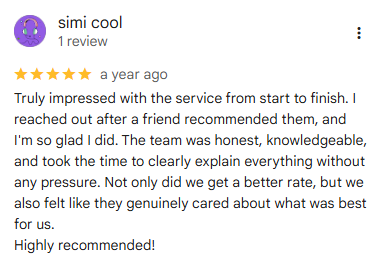
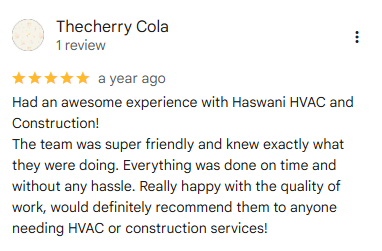
Every published review is five stars, on Google and on Yelp. These are screenshots of the live profiles.



Why people call us
Why homeowners here choose Haswani
Three things that are checkable rather than assertable. Each one is either a number you can verify or something the company can actually do.
The reviews are screenshots, not retyped quotes
All 12 reviews on this site are shown as screenshots of the live Google and Yelp profiles, ten on Google and two on Yelp. A quote retyped into a web page is indistinguishable from one a marketer invented; a screenshot carries the platform’s own chrome, the reviewer’s name and the date. No average rating is claimed anywhere, because 12 screenshots prove these reviews exist without proving they are the complete set.
A duct that has to move does not become somebody else’s job
Haswani runs HVAC alongside construction, electrical and plumbing. A large share of comfort complaints are building problems rather than equipment failures: a return opening undersized when the house was framed, a duct run that has to be rerouted, a circuit that will not carry the new equipment. Most HVAC companies stop where the building begins and hand that off. Here it stays with the same company.
Somebody answers at two in the morning
Emergency HVAC service runs around the clock. Cooling failures are not spread evenly across the year: they cluster on the hottest afternoons, in a city averaging 102 days at or above 90°F. Office hours are monday - saturday, 9:00am - 6:00pm, and the emergency line is not bound by them. The office is on Murphy Road in Stafford, which puts the core service area within about fifteen minutes.
Uneven cooling questions
Why is one room always hotter than the rest?
Can closing vents in cold rooms fix a hot room?
Does a smart thermostat help with uneven rooms?
Is it worth adding a vent to the hot room?
Knowing which rooms, and at what time of day, narrows this down before anyone measures anything.
Call (855) 758-5353One room nobody wants to use in summer
Worth measuring rather than guessing. The fix is often a damper and a duct correction rather than anything expensive.