Component
Refrigerant leak detection and repair
Refrigerant is not consumed by a working system. If yours is low, it is going somewhere, and adding more without finding out where has become an expensive habit.
Why "low on refrigerant" is never the whole story
A sealed refrigeration circuit does not use up refrigerant. It circulates the same charge indefinitely. So a system that is low has lost charge to a leak, and the size of the leak determines how quickly it comes back.
This matters because the industry has a long habit of selling a top-up as a repair. It restores cooling for a while, and the customer comes back next season with the same problem and a bigger bill.
What matters is not how much refrigerant the system needs. It is where the leak is, and whether fixing it is worth doing on this particular system.
Signs of low charge
- Cooling that has weakened gradually over one or more seasons
- Ice forming on the copper suction line near the outdoor unit
- A small temperature difference between return and supply air
- The system running far longer than it used to for the same result
- A hissing or bubbling sound near the indoor coil
- Electricity bills climbing without a change in habits
A system that was recharged last year and is low again has a leak large enough to be worth finding.
Call (855) 758-5353Where leaks happen
The usual locations, and what each means for the repair
The evaporator coil
The most common and least welcome location. Evaporator coils develop pinhole leaks through corrosion, often formicary corrosion driven by compounds in ordinary indoor air acting on the thin copper tubing. On a coil that is leaking in multiple places, repair is not practical and the coil is replaced. See evaporator coil replacement.
Fittings, service valves and Schrader cores
The good news category. Leaks at flare fittings, service valve stems and Schrader valve cores are common, inexpensive and genuinely repairable. A technician who finds one of these has found you the cheap version of this problem.
The line set
The copper lines running between indoor and outdoor units, often through walls or under a slab. Leaks here happen from physical damage, vibration wear where lines contact framing, or corrosion. Repair depends entirely on access. A line set leak in an accessible attic run is straightforward. One under a slab is not.
The condenser coil
Outdoor coils get damaged by hail, lawn equipment, and years of weather. Sometimes repairable, sometimes not, depending on where the damage is and how much of the coil is affected.
The compressor and its connections
Leaks at compressor connections or through a failing compressor housing are usually accompanied by other problems, and typically point toward larger decisions. See compressor replacement.
The process
How a leak actually gets found
Leak detection is a specific procedure rather than a look around the equipment.
Confirm the system is genuinely low
Pressures, superheat and subcooling measured against manufacturer specification. Poor cooling has other causes, and confirming low charge comes before hunting for a leak.
Locate it
Electronic leak detection, ultraviolet dye where appropriate, and pressure testing with nitrogen on a system that has lost its charge entirely. Small leaks in awkward locations can take real time to find.
Assess whether it is worth repairing
A leaking fitting is a straightforward fix. A coil leaking in several places on a fourteen year old system is a different conversation, and an honest technician has it before doing the work rather than after.
Repair and verify
The repair itself, then pressure testing to confirm the system holds before any refrigerant goes back in. Skipping the hold test is how people end up paying for the same job twice.
Evacuate and recharge to specification
Proper evacuation removes air and moisture from the circuit, then the system is charged by weight to the manufacturer specification rather than topped up until it feels about right.
What changed in 2025
The refrigerant phase-down is now part of the decision
Under the EPA’s AIM Act, production and import of new residential split systems using R-410A stopped at the start of 2025, in favour of lower global warming potential refrigerants such as R-454B and R-32. Existing systems can still be serviced, and equipment manufactured before the cutoff can still be installed until stocks run out.
The consequence that matters to a homeowner with an older system is price. As the production cap on R-410A tightens, its wholesale cost has risen substantially from where it sat a few years ago, and that trend continues rather than reverses.
So the arithmetic on a recurring leak has changed. A system that needed a top-up every couple of summers was an annoyance in 2020. On an ageing system today it is a recurring and rising cost, sitting on equipment that is closer to replacement each year.
None of that means replace it automatically. It does mean the comparison deserves real numbers rather than a shrug. See AC replacement and the cost calculator.
What repair typically costs
Published data puts leak detection, repair and recharge broadly in the $200 to $1,600 range with an average near $800, rising considerably when a coil or line set has to be replaced.
The spread reflects the job rather than the market. A Schrader core and a leaking evaporator coil are not comparable pieces of work.
Ranges come from published Houston-area and national pricing data. Sources and assumptions are listed on the calculator page.
Call (855) 758-5353Related pages
Frozen AC coil
Low charge is one of the two main causes of a coil icing up.
AC not cooling
The symptom that usually leads here.
Evaporator coil replacement
Where most non-repairable leaks are found.
Compressor replacement
What running a system low on charge eventually causes.
AC replacement
When repeated leak repair stops making financial sense.
Cost calculator
Repair and replacement ranges side by side.
Reviews
What customers say
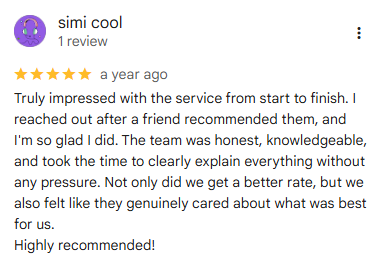
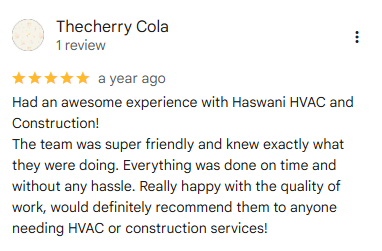
Every published review is five stars, on Google and on Yelp. These are screenshots of the live profiles.



Why people call us
Why homeowners here choose Haswani
Three things that are checkable rather than assertable. Each one is either a number you can verify or something the company can actually do.
The reviews are screenshots, not retyped quotes
All 12 reviews on this site are shown as screenshots of the live Google and Yelp profiles, ten on Google and two on Yelp. A quote retyped into a web page is indistinguishable from one a marketer invented; a screenshot carries the platform’s own chrome, the reviewer’s name and the date. No average rating is claimed anywhere, because 12 screenshots prove these reviews exist without proving they are the complete set.
A duct that has to move does not become somebody else’s job
Haswani runs HVAC alongside construction, electrical and plumbing. A large share of comfort complaints are building problems rather than equipment failures: a return opening undersized when the house was framed, a duct run that has to be rerouted, a circuit that will not carry the new equipment. Most HVAC companies stop where the building begins and hand that off. Here it stays with the same company.
Somebody answers at two in the morning
Emergency HVAC service runs around the clock. Cooling failures are not spread evenly across the year: they cluster on the hottest afternoons, in a city averaging 102 days at or above 90°F. Office hours are monday - saturday, 9:00am - 6:00pm, and the emergency line is not bound by them. The office is on Murphy Road in Stafford, which puts the core service area within about fifteen minutes.
Refrigerant questions
Can you just add refrigerant and see how it goes?
What does refrigerant leak repair cost?
Is refrigerant dangerous to me or my family?
My system uses R-410A. Can it still be repaired?
If your system has been topped up before, the leak is still there. Worth finding this time.
Call (855) 758-5353Cooling weaker every summer?
That pattern is a leak until proven otherwise. Finding it is a different job from topping it up, and a considerably better use of the money.