Harris County, City of Houston
AC repair and HVAC service in Brays Oaks and Fondren Southwest
The one part of this service area where the typical cooling system is not in a house. Closet air handlers, shared drain stacks and condensers in a rack change the job considerably.
Local context
An apartment boom that never got undone
This area began as ranch land and single-family houses on large lots. Then in the late 1970s and early 1980s a great deal of multifamily development arrived across an eight square mile stretch, and it changed the character of the place permanently.
By 1990 the split was roughly 60 percent multifamily to 40 percent single family. As of 2005 there were something like 76 apartment complexes holding more than 15,000 units, alongside about 12,000 single-family houses. The mid-1980s oil crash hit the area hard, property values fell, and recovery only began in the mid-1990s.
The 2005 rebranding to Brays Oaks came with a management district, a 2009 master plan and a sustained effort to give the area a coherent identity again. The district office is in the Brays Oaks Towers on Fondren Road.
For HVAC work the housing mix is the whole story. Across the rest of southwest Houston the default job is a detached house with an attic air handler. Here it is a unit inside a building, and the constraints are completely different.
Brays Oaks at a glance
- Former name: Fondren Southwest, until 2005
- District created: June 2005, by the 79th Texas Legislature
- Also known as: Harris County Improvement District 5
- Size: about 15 square miles since 2011
- Housing mix: multifamily-dominant since the 1980s
- County: Harris
- Permitting: Houston Permitting Center
Apartments, condos and townhomes
What changes when the system is in a building rather than a house
The drain is shared
In a house, a condensate drain is yours alone and terminates outside a wall. In a stacked building it often ties into a common line serving several units, which means a blockage downstream of you can back water up into your pan even when your section is clear. Diagnosing that takes knowing the building, not just the unit.
The condenser is not yours alone
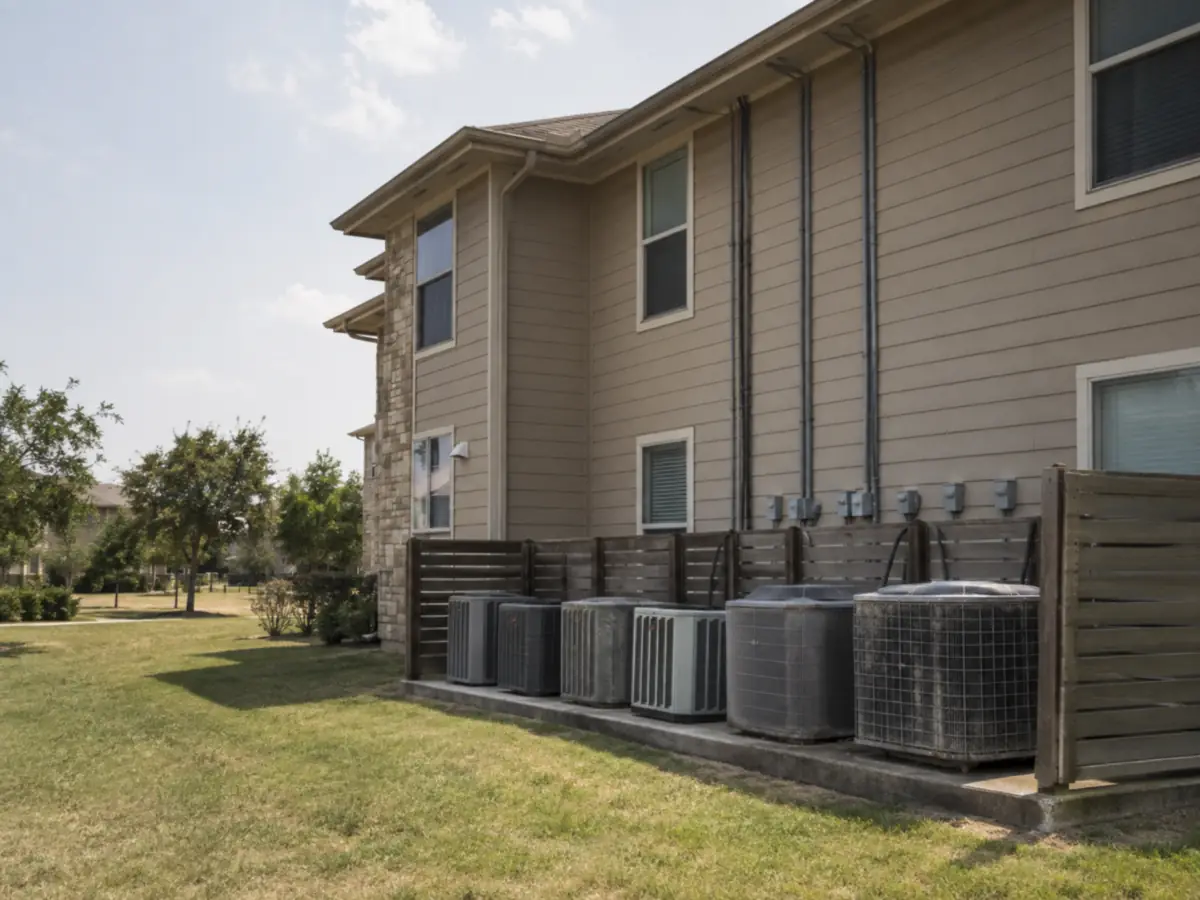
Outdoor units here are frequently in a fenced rack or on a shared slab, sometimes several floors below the unit they serve, and occasionally not obviously matched to the right apartment. Long vertical line sets have their own rules about oil return and sizing that a house rarely raises.
Access is a real constraint
No attic, a closet with a door narrower than the equipment, an interior corridor and no lift. This is why some replacements in these buildings take longer than the same work in a house, and why a technician should see the space before quoting rather than after.
There is also an ownership question that does not exist in a detached house. Before any replacement in a condo or a managed townhome, it is worth establishing who owns the indoor unit, who owns the condenser, who owns the line set between them, and whether the association has rules about equipment type or placement. Sorting that out first avoids a much more awkward conversation later.
The single-family streets
And then there are the 1960s and 1970s houses
Braeburn Valley West, Glenshire, Northfield and Westbury account for most of the single-family stock, and that housing behaves like its era rather than like the apartments beside it. Single storey, slab on grade, shallow attic, equipment in a closet or a low attic space, and duct systems that have been extended rather than designed.
The recurring findings are the ones that apply across mid-century southwest Houston: a return sized for the original equipment, long supply runs with pressure losses at every bend, and a house that has been modified several times without the distribution ever being reassessed. See ductwork.
Where this area differs is in what a good answer looks like. In a large single-family neighbourhood, correcting the duct is usually worth doing properly. In a small 1970s house, or in a townhome, a ductless head serving the one room that has never worked is frequently a better use of the same money than reworking a whole distribution system to fix one room.
Which of the two is right depends on the room, the building and the budget, so it is worth asking for both to be priced rather than accepting the larger job by default.
There is one more pattern specific to smaller units. Where the equipment is generously sized for the space, the system reaches setpoint in a few minutes, shuts off, and repeats. That is short cycling. It wears components quickly and leaves the place cool but humid, because the coil never runs long enough to pull water out of the air.
The district
From South Post Oak west to US 59
Bissonnet forms the northern edge and US 90A the southern one, with Westbury, Braeburn Valley and Glenshire inside it and Sharpstown across the freeway.
Services here
HVAC work we do in Brays Oaks and Fondren Southwest
AC repair
Houses, apartments, condos and townhomes, which are four different jobs.
Drain line service
Including shared stacks where the blockage is not in your unit.
Mini-splits
Often the right answer for one room, or where duct is not practical.
Short cycling
Common where equipment is generous for the space it serves.
Ductwork
For the 1960s and 1970s single-family sections.
Commercial HVAC
Multifamily common areas, offices and retail along the corridors.
Nearby areas and related pages
Westbury
Inside the district, and almost entirely single-family.
Sharpstown
North-west across the freeway, with a similar commercial mix.
Southwest Houston
The regional picture and the 1950s duct argument.
Mini-splits
Where a ducted answer is impractical or disproportionate.
AC water leak
What to check first when water appears in a stacked building.
AC not turning on
Including the breaker and float switch checks worth doing yourself.
Brays Oaks and Fondren Southwest questions
Is Brays Oaks the same place as Fondren Southwest?
I live in a condo. Who is responsible for the air conditioning?
My air handler is in a closet with no attic above it. Is that a problem?
Can you work on a three-storey townhome where the equipment is on the top floor?
Which single-family neighbourhoods are in the district?
House, condo, apartment or townhome? In this part of Houston that is the first thing worth saying.
Call (855) 758-5353Condo or townhome cooling problem?
Tell us the building type and where the equipment sits. Half the diagnosis in a stacked building happens before anyone arrives.