Fort Bend County
AC repair and HVAC service in Rosenberg, Texas
A town whose oldest houses were designed to survive a Texas summer without mechanical cooling, and which have spent the last seventy years being adapted to it.
Local context
The town exists because of a railway junction
In 1880 the railroad built a station three miles west of Richmond, where the Gulf, Colorado and Santa Fe crossed the Galveston, Harrisburg and San Antonio. In 1883 the Santa Fe bought 200 acres from the Henry Scott league and platted a town around a square. It was named for Henry Rosenberg, a Swiss immigrant who arrived in Texas in 1843 and became the railway’s first president.
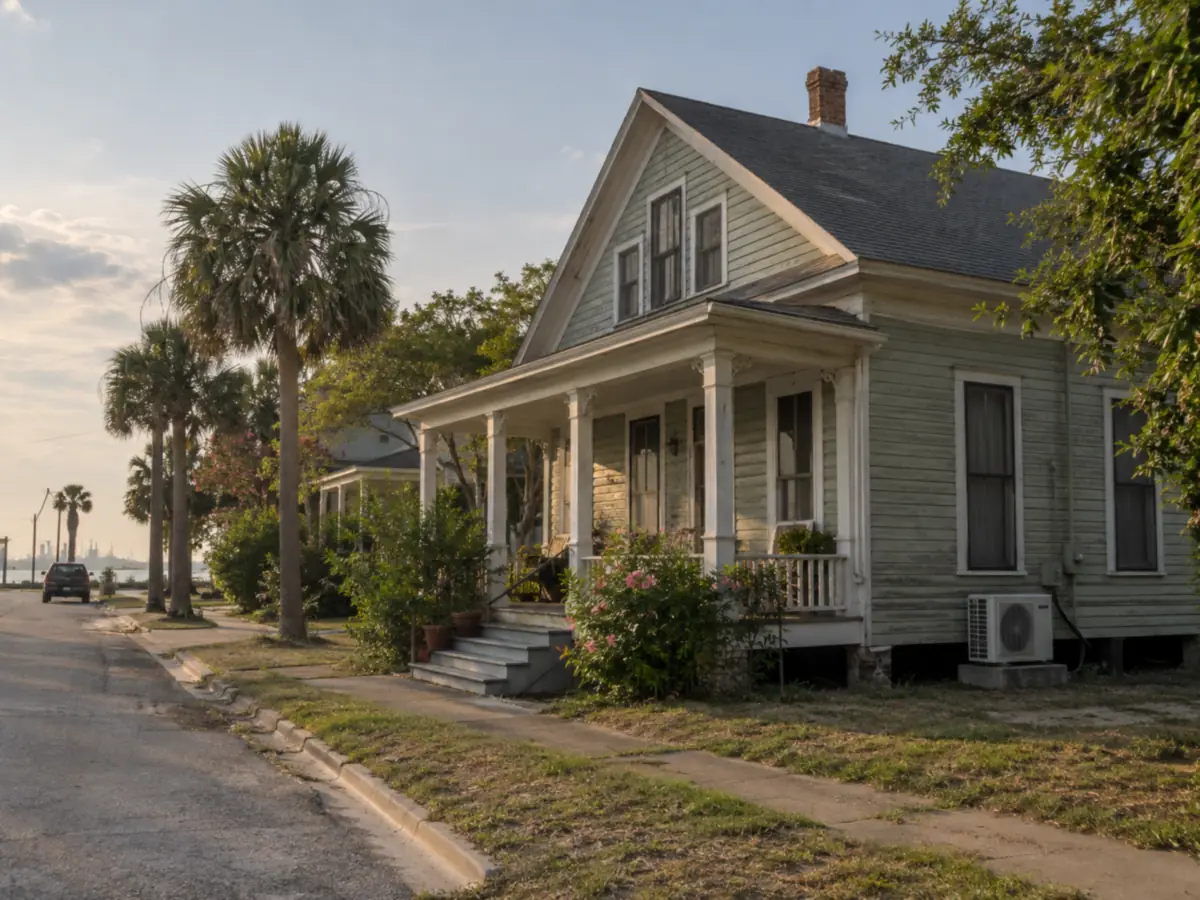
That origin is still legible. The downtown buildings on Third Street date from the 1880s, and the residential streets behind them include the substantial houses that went up for local business families, among them a two-storey classical revival residence built in 1910 on what was known locally as silk stocking row.
Then the city grew: 30,618 residents in 2010, 38,282 in 2020, with estimates around 42,700 by 2025, across 37 square miles. Interstate 69 runs through the southern part of the city and Houston is about 32 miles north-east.
Two housing populations, then, separated by roughly a century of building practice and by the arrival of mechanical cooling.
Rosenberg at a glance
- Founded: as a railway town, platted 1883
- Population: 38,282 at the 2020 census
- Growth: about 25 percent from 2010 to 2020
- Area: roughly 37 square miles
- County: Fort Bend
- ZIP codes: 77471 and 77469
- Schools: Lamar Consolidated ISD
Older housing
Houses built before the thing you are asking them to do
Residential refrigerated air did not become normal in Texas houses until well after the Second World War. Much of the housing near Rosenberg’s original town square predates that entirely, which means the cooling system in those houses was added to a building that was never designed around one.
Four consequences turn up repeatedly, and none of them is a fault in the equipment.
The duct went wherever it fitted. Not along a designed route with calculated branch sizing, but through whatever attic space, closet or boxed soffit was available when the work was done. Long runs, sharp turns and undersized branches are the normal result, and each of them costs airflow.
The return is an afterthought. Early retrofits often put in one small return grille because that was what would fit. A modern air handler moving considerably more air through that same opening runs at high static pressure, which reduces capacity, stresses the blower motor and can drive coil temperatures low enough to freeze the evaporator.
The envelope leaks. A house built for ventilation is not sealed, and in a climate with humidity averaging around 75% that means the system is dehumidifying outdoor air all summer as well as cooling the house. Air sealing and attic insulation frequently return more comfort per pound spent than equipment does.
Where the floor is not a slab, duct may run in a crawl space rather than an attic, which changes access, insulation condition and where leaks show up. Worth establishing early rather than assuming the attic pattern that applies almost everywhere else in this service area.
Newer housing
And then there is everything built since 2010
Nearly eight thousand people arrived between the 2010 and 2020 censuses, and most of them moved into houses that had not existed before. Those properties have almost nothing in common with the town centre.
Tighter envelopes, ducted systems designed alongside the house, equipment still young enough that component failure is the exception. What shows up instead is the modern-construction pattern: a house that reaches its setpoint quickly, shuts off, and never runs long enough to dehumidify properly, so it reads cool and feels damp. See humidity and indoor air quality.
The other recurring item is the room that was never going to work: over a garage, at the end of the longest run, or on a west-facing corner with a lot of glass. In new construction that is a balancing and airflow question, not an equipment one.
Winter matters here too. A Gulf Coast heating system spends most of the year idle, which is exactly why it fails on the first genuinely cold night. See heating and furnace service.
Worth knowing before you call
- Roughly when the house was built, even approximately
- Whether the foundation is a slab or pier and beam
- Where the indoor unit is and how you get to it
- Whether the ceilings are high in the affected rooms
- What the system is doing now
24/7 emergency HVAC service. Office monday - saturday, 9:00am - 6:00pm.
The city
Rosenberg and Richmond, side by side
Richmond adjoins to the north-east across the Brazos, and Interstate 69 crosses the southern part of the city on its way to Houston.
Services here
HVAC work we do in Rosenberg
Ductwork
The first thing to test in a retrofitted older house.
Mini-splits
For rooms a ducted system was never realistically going to serve.
Zoning and airflow
Balancing before capacity, in both halves of this city.
AC replacement
With the city permit and inspection handled as part of the job.
Heating
Equipment that sits unused for months and then gets asked for everything.
AC repair
Diagnosis, including on equipment nobody has looked at in years.
Nearby areas and related pages
Richmond
Immediately north-east, and the county seat.
Sugar Land
East along US 90A, and a much newer housing stock.
Katy
North along the Grand Parkway.
Zoning and airflow
Why balancing usually beats buying capacity.
Frozen AC coil
What a badly restricted return eventually produces.
Heating and furnace
The system nobody thinks about until January.
Rosenberg questions
Can an old house in downtown Rosenberg be properly air conditioned?
Does Rosenberg require a permit for a system changeout?
Our ceilings are high and the upstairs rooms never cool. Why?
Do you cover the newer subdivisions on the west and south sides?
How far out is Rosenberg from you?
An old house and a new house in this city need completely different answers. Say roughly when yours was built.
Call (855) 758-5353Rosenberg address, honest travel time
About twenty miles west of the office. Straightforward for planned work, and worth calling to get a realistic window for anything urgent.